Tuesday, February 8, 2011

Get Ready to Raft: Guide School at NOC

This blog has moved. You will be redirected to the new blog in 5 seconds. If your browser does not redirect, please click the following URL:

http://www.noc.com/blog/get-ready-to-raft-guide-school-at-noc/

So what if the average high in early March is only in the upper 50s, or if the lows reach into the 20s? When March is here, rafting season is too—at least for the aspiring raft guides and diehard whitewater lovers at NOC’s annual Raft Guide Schools.

The program is a five-day introduction to life as a professional river guide. Guides in training learn to master raft control and how to deal with the weight and momentum of large, eight-person rafts. They also get to learn whitewater features, rescue skills, how to carry rafts, the soft skills and more. Not just for aspiring guides, the program is perfect for "average" river enthusiasts who enjoy guiding their friends down the Nantahala in a rental raft and for rescue professionals looking to increase their rafting skills.


The course takes place on the Nantahala and French Broad Rivers, and the it boasts a fun “we’re all in this together” group mentality that provides built-in support and camaraderie for all participants.


This year’s course offerings begin in February and extend until mid-April. Typically guide schools receive a high percentage of college-age students looking for an exciting summer job, but there are also participants looking for an alternative spring adventure. On-campus lodging and dining are included in the price, so it’s really an easy pre-packaged spring break.


If you’re interested in learning more about this unique week of whitewater, read this discussion I had with eleven-year veteran Will Norris, an NOC Head Guide on the Class V Cheoah River. Will leads a guide school every other week during the spring (trading off with Stephan Hart—one of NOC’s only guides to be “checked out” on all seven rivers).


Will actually led my guide school four seasons ago, so I knew a few good questions to ask.


NOC guide school instructor Will Norris by the banks of the Nantahala at a 2008 guide school.


Charles: Do you prefer students to have previous whitewater experience?


Will: No, as a matter of fact many times we’ve seen students with no experience do better than avid kayakers. Sometimes kayakers have a harder time dealing with all the extra weight and momentum [of a raft], and they’re typically harder on themselves if they can’t get it right away. Sometimes a blank slate is easier to work with.


Charles: For the students seeking employment at NOC, there’s an evaluation of their skills. What are you looking for?


Will: We focus on raft control, but there are five main categories we rate; it’s not all about raft control. If we see the learning progression is happening, and that you’re working well with others—like you’ve got a great personality and that you’d be good at working with guests—well, that plays a huge part in it.


Charles: What parts of the course are the most challenging for students?


Will: One of the more challenging elements is the aggressive swim, when we’re actually getting out in the river. It’s physically demanding for many students, and it’s always cold.


Charles: That’s on the Nantahala from above the rentals take out to the pedestrian bridge, right?


Will: Right. I almost always try to do this at the end of the first day, so that students have experience with swimming if they come out of the raft the rest of the week. Here we talk about the different safety aspects of entering the water—body angle, moving through current, crossing current—we tie it in with positioning your body like a watercraft.


Charles: What else is challenging?


Will: For many folks it’s just dealing with all that weight and momentum in the boat. The flip drill is also anxiously anticipated. [This requires the guides to flip the raft to practice flipping the raft back over in moving water.] I almost always do this drill at the pool below Frank Bell’s rapid on the French Broad.


Charles: Frank Bell’s can be a class IV rapid at some water levels—is this the biggest rapid of the week?


Will: Yeah, Frank Bell’s is the biggest rapid we’ll do. Pillow, the Ledges and Kayaker’s Ledge are all in play on the French Broad, so every student in a training raft will get to guide at least one class III rapid on the FB. That’s in addition to the Fantasy Island drill on the Nantahala, where the teams do laps on Nantahala Falls. During that drill, the students carry the rafts back up each time so that each guide gets three runs on the rapid.


Charles: So the guides have to carry the rafts back up the river over ten times. I don't remember that being a major challenge.


Will: Usually students don’t know what to expect going into the drill, but they figure out an efficient system for transporting the rafts and they enjoy it. Usually several groups keep going past the three-run requirement.


Charles: What about weather? It’s still cold outside in March.


Will: Weather can be a large mental factor, usually much more than a physical factor. We let the students know what to bring and we provide necessary gear. Some of the folks you'd expect to be cold and weaker in those conditions surprise you and thrive, while the bigger and stronger participants don’t always handle them as well. We tell the students, if you can make it through this you’ll be even more comfortable in July in your Chacos, river shorts and sunglasses.


Charles: It’s good for the guides to feel the impact of weather on the rafting experience I suppose.


Will: Yes, that’s the upside of making the guides swim in cold water and in cold weather. You can feel what a guest would feel if he or she were to fall out, and it teaches you to be ready with the equipment and gear to respond.


Charles: How physical is guide school?


Will: In five days you do a physical activity every day. You don’t need to be an athlete to do it, but this course shows you what you’ll be putting your body through every day as a guide. Everything is hands on—from rope tying, to loading rafts, to rescue practice.


Charles: Do you stick to a tight schedule?


Will: We have a syllabus and a skills-progression order, but we’re flexible enough to use moments of opportunity. Pinning a raft may present the perfect opportunity to practice unpinning a raft. The first two days are the most critical learning days. By day three folks are getting dialed in, and there’s less emphasis on teaching the control skills. By then we’re fine tuning and working on other necessary skills.


Charles: Anything else you'd like to mention?


Will: We incorporate fun and keep things as light as possible. For a lot of folks it's their spring break, and we don't want them to feel like it's another day in class or at work.


For more photos from previous guide schools see the photo gallery on the guide school page at noc.com.


I’ll leave you with a photo from my guide school in 2007. For the record, I believe we all had a blast, and I think the only time I felt cold was actually on the lake learning the basics. The rest of the time I was pretty focused on the activity.


Except for the swim drill; no doubt, that was cold.

Tuesday, January 11, 2011

Paddling School and Wilderness Survival School Announce 2011 Calendars

2011 Paddling School Calendar
2011 Wilderness Survival School Calendar


Two of NOC’s most popular programs, the Paddling School and Wilderness Survival School, will provide even more learning opportunities this year with expanded curriculums, new courses and more dates.


Learning to surf at a private instruction session with
NOC Paddling School instructor Anne Sontheimer.


Under the direction of Jon Clark the Paddling School (and its staff of over 30 instructors) has adapted its 2011 schedule to offer the most variety possible for all skill levels and ages. The 2011 PS Calendar is packed full of whitewater kayaking and canoe courses, women’s only sessions, kids and teen kayak programs, as well as an array of leadership courses including ACA Swiftwater Rescue, the all new Youth River Leadership course, and NOC’s famous Raft Guide School.


Paddlers should also consider affordable one-day workshops on rolling and paddling the Nantahala, and the always-popular private instruction session, where you dictate your itinerary with one of the best paddling instructors in the world. Whether you have one day, a weekend, or a week to spend on the water, NOC Paddling School has the fun courses that will develop your paddling skills.


Survival school students learn basic trapping methods
at NOC's Hemlock Ridge survival course.


It's hard to imagine that NOC's Wilderness Survival School (WSS) started this time last year! Thanks to higher-than-anticipated demand our instructors have accelerated the development of the program curriculum, which debuts this season. This program's goal is to provide participants all the tools needed to survive in challenging wilderness environments. The process involves three stages of progression and multiple skills workshops along the way to hone in on specialty areas.


The 2011 WSS Calendar offers the opportunity to complete the entire progression in 2011. Also, there are special offerings like a Father/Son Survival Weekend Retreat (mothers and daughters are encouraged to attend as well!) and an Ultimate Survival Youth Camp—the coolest summer camp for outdoor-loving kids. Our instructors' philosophy is one of advancement through experience, so expect to build your own shelter, refine your knife skills and learn to start fires with your own two hands. These courses are just as fun as they are enriching!

Friday, January 7, 2011

NOC Special Events 2011: What to Expect

This blog has moved. You will be redirected to the new blog in 5 seconds. If your browser does not redirect, please click the following URL:

http://www.noc.com/blog/noc-special-events-2011-what-to-expect/

2011 NOC Special Events Calendar

While working on the new 2011 special events calendar I took the opportunity to reflect on how NOC special events have changed over the past couple of years. If you're really just interested in the events, follow the link above see the schedule on noc.com for yourself. It features a good mix of participatory and spectator events, old standbys and new trial offerings.

Be sure to note the 2011 USA Canoe/Kayak Slalom Nationals will be on the Nantahala the weekend after GAF, so we'll likely get to see the 2012 Olympic paddlers here in Wesser even though the team won't be set until next year. If you are interested in how the NOC special events schedule has evolved, keep reading. You may find the following observations interesting.

Over the past couple of years NOC has tried to bring most special events “home” to the main Nantahala property. This meant handing off longtime NOC events like the Knobscorcher and the Tsali Challenge Triathlon to race promoter Gone Riding, but the upside of this transition has been the creation of very successful new events, and a plan for future on-property bike and foot races as the Flint Ridge trail system develops into an accessible, event-worthy venue in the next few years.


The stars of the new event calendar have been the NOC Freestyle Shootout and last year’s Canoe Club Challenge. The NOC Freestyle Shootout is part of the burgeoning eleven-event USA Freestyle Kayak Points Series which will determine the 2011 freestyle team and national champions. Also, the event helped the Nantahala Gorge win the 2013 ICF World Freestyle Championships, which will be the biggest paddling event ever held on the Nantahala or in the area, bringing in paddlers and spectators from over 25 different nations. Last year’s NOC Freestyle Shootout featured eight classes from open beginner to professional, giving boaters of all skill levels the chance to compete together. Thanks to its centralized location among NOC’s facilities the freestyle event is uniquely spectator-friendly, and it gives paddlers a shot-in-the arm heading into the summer boating season.


Friday night at the NOC Freestyle Shootout offers an illuminated practice session
giving traveling paddlers pre-event time in the feature.


The Canoe Club Challenge is a short gate race spanning the bridges on the Nantahala behind the Outfitter’s Store. While prizes are awarded for individual classes, the real competition in the Canoe Club Challenge is not speed, but participation. Paddling clubs compete for total “starts” and encourage members to get out and paddle together. The result was the largest paddling event in the United States last year, with over four hundred recorded starts. The short course and convenient location afford paddlers a fun, social event where they can work on technique and speed, as well as goof off and meet new paddling buddies. Non-club boaters are welcome at the event, and are actually heavily recruited by clubs looking for representatives to log some additional starts. The Canoe Club Challenge will again consist of three rounds throughout the summer.


Canoe Club Challenge paddlers waiting for the queue to start their runs
through the race gates.


Also new in 2010 was the Duck N’ Run race, a light-hearted “adventure race for everyone” consisting of a five-mile whitewater duckie paddle on the Nantahala (including Nantahala Falls), and a five-mile run on NOC’s Flint-Ridge Trail. This race and the new-for-2011 Nantahala River Raft Race give everyone, not just competitive athletes, opportunities to participate and win cool events. (By the way, our 2010 Duck N’ Run training videos were a big hit on the NOC Facebook page, and are worth a peek.) The new downriver raft race will present teams of four a chance to claim the official “fastest crew on the Nanthala” title.


Duck N' Run participants await the start signal at Ledges Rapid on the Nantahala River.


Another new event that established itself in 2010 is the Great Pumpkin Pursuit at NOCtoberfest. Our costumed race hosts chunked over 50 numbered pumpkins from rafts in Nantahala Falls for boaters to collect and redeem for prizes, including a new kayak. In 2011 we expect to toss over 100 pumpkins in the river from multiple rafts and to see the costume component of the event grow.


The 2010 Great Pumpkin Pursuit unfolds as paddlers chase pumpkins through
Nantahala Falls.


As for more serious events, NOC is working with the Smoky Mountain Relay to put on a 200+ mile relay running race extending from the Asheville area to Wesser. Teams of six and twelve runners will complete the course in just two days.

There’s also the
Blue Ridge Breakaway bike race sponsored and supported by NOC (but organized by our friends at the Haywood Chamber of Commerce), that offers riders 24, 40, 66 and 105 mile ride options. Last year over 300 riders rode in the inaugural Blue Ridge Breakaway, and with the ride’s stellar organization, location and routes there’s every reason to expect this one to grow. We do have plans to introduce a new NOC-run cycling event in 2011, but we haven't received required permits yet. More details to come as our planning pans out.

New in April 2011 is an Appalachian Trail celebration we’re calling the Founder’s Bridge Festival, recognizing the bridge where the AT bisects NOC and crosses the Nantahala River. Expect vendors from leading gear producers, representative from area hiking clubs, free workshops, survival skills courses, speakers, book signings and live music—all focused on celebrating the nation’s most beloved footpath.


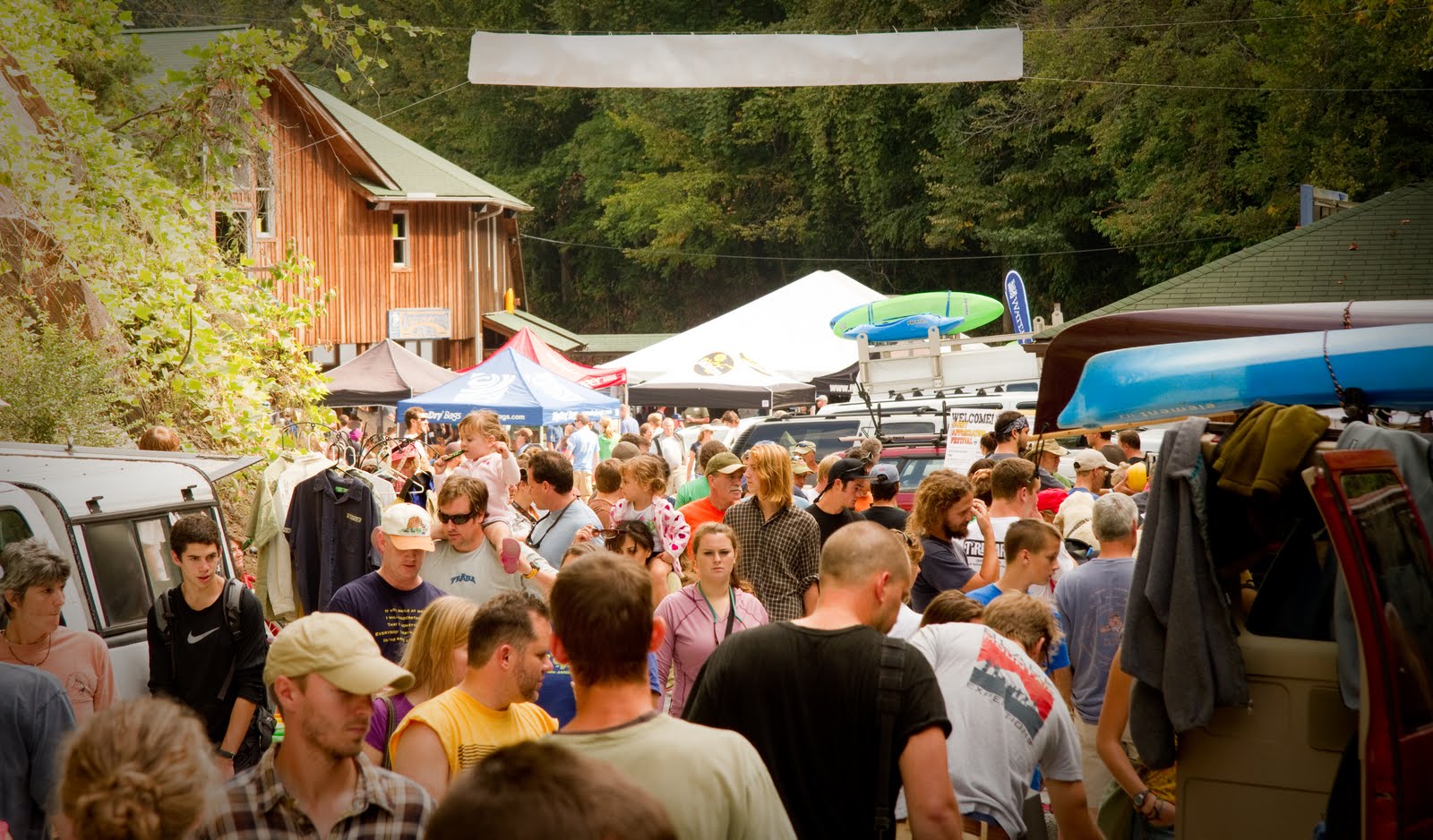
NOC’s popular retail events—spring’s Demo Days and summer’s Sizzling Sales Days—will return offering the best deals on new gear and the best savings of the year—short of GAF, of course. GAF 2010 was widely hailed as the “best GAF ever” (click here to see why), but we’ll do our best to make GAF 2011 even better.


Throngs of outdoor enthusiasts swarm the Used Gear Marketplace at GAF 2010.


All of these events will be supported with nighttime entertainment at The Pourover beside the banks of the Nanthala—one of the coolest places to see live music and enjoy being away from workaday responsibilities. We'll be returning our “Rock and Raft” music series and rafting promotion, which offers discounted 4pm trips that end in time for dinner and featured bands from Asheville, NC—a hotbed of cool, funky music.

As we look beyond 2011 we plan to develop Flint Ridge into a trails system that will accommodate competitive events for athletes of all skill levels. To this end, we also will be holding a Spring and a Fall Trail Days (to be announced), where we'll invite guests to help us do some work on this trail system. Once finished, Flint Ridge will be accessible (and free!) to riders and runners year round, with all the conveniences of being located at NOC. (No permitting issues or closures either.)


So, that’s the deal with NOC special events moving forward. I hope you plan on joining us at some of these in 2011. We’re open to feedback and suggestions about the kinds of events our guests want to see, so feel free to comment here, on NOC's Facebook page or send an email to info@noc.com. It’s never too late to add another event to the calendar—just keep in mind that there’s only so much we can do, especially in the summer!


Thanks for supporting NOC and best of luck in the new year.

Charles Conner
NOC Marketing

Tuesday, August 3, 2010

NC Bartram Trail Hike

Our friend Cliff Hardin recently wrote a good guide about hiking a 58 mile loop of the NC Bartram Trails and the Appalachian Trail, starting and ending at the NOC. This hike can be done in 5 days, following the guide below. A 3-day version of the hike is also described at the end of the article:

"A Great Hike" by Cliff Hardin

"Hikers seeking a great hike should consider the 58 mile loop hike, utilizing the Appalachian and NC Bartram Trails, starting and ending at the Nantahala Outdoor Center.

Since this hike starts and finishes at the same place, the NOC can be used as a "base camp". This allows you to take advantage of the NOC's lodging and great restaurants the night before and the night after the hike.

You can also make arrangements to leave your vehicle in a secure parking lot. Contact NOC reservations at 1-888-905-7238 or visit their website www.noc.com for more information.

Tip: I personally like to stay in the Bartram Bunkhouse and always request one of the 2 bunk rooms, a bargain at $16 per person, per night.

5 Day, 58 mile hike:
Day One: 11.6 miles: After a good night's rest and a great breakfast at the NOC's River's End Restaurant, take the AT South from NOC. Hike to Cold Spring Shelter; spend the first night in the shelter. Water is available here, be sure to treat or filter the water. Keep in mind a lot of the 11.6 miles will be uphill, as you will be climbing to Wayah Bald the first day and part of the second day. Plan on a few rest breaks and carry enough water for the day's hike.

Day Two: 10.9 miles: It is 5.9 miles from Cold Spring Shelter to Wayah Bald, with the AT and NC Bartram Trails joining just North of the summit (5,385'). Wayah Bald would be a great place for lunch, while you enjoy some awesome views, from the tower, that was built by the Civilian Conservation Corps in 1937. After you enjoy lunch and hopefully take some great pictures, take the Appalachian/Bartram Trail for 1.8 miles to Wine Springs. The BT and AT separate here. You may want to get water here before hiking on to Jarrett Bald, where you will camp for the night.

Day Three:
12.3 miles: The hike starts out with downhill for 2.5 miles to Nantahala Lake (SR 1310). After about a mile of road walking you will come to a store, on the left, where you can get a cold drink and obtain water for the rest of the day's hike. It's 9.7 miles to Piercy Creek, where you will find some nice camp sites, with water available from the creek.

Day Four:
10.8 miles: After 7.3 miles, with a lot of downhill, you will reach Nantahala River Launch (US Hwy 19/74). Be sure to go by the Bartram Historical Marker, for pictures, before hiking the 3.5 miles to the 2nd crossing of Ledbetter Creek, your camp site for the night.

Day Five:
11.5 miles: It's 3.7 miles to Cheoah Bald (5,062'), the northern terminus of the NC Bartram Trail. From here take the AT 7.8 miles to finish the hike at NOC. Be sure to allow time for pictures at Bartram Falls and at the summit of Cheoah Bald.

After a good meal, a hot shower and good nights rest, you will be ready for the trip home, carrying with you memories of a great hike and hopefully some great pictures.

It's possible to make this a 3 day, 40 mile hike by getting a shuttle from NOC to Wayah Bald, thus eliminating the climb from NOC to Wayah Bald on the AT.

Tip: I have been successful in obtaining an early morning shuttle for my Bartram thru-hikes from NOC employees prior to their going to work. You can still leave your vehicle in a secure parking lot and will be hiking back to the NOC.

3 day, 40 mile hike:
Day One: 13.5 miles: Wayah Bald to Nantahala Lake 7.5 miles, then 6 miles to Appletree Campgrounds. There are nice camp sites, just north of Appletree.
Day Two: 15 miles from Appletree Campgrounds to 2nd crossing of Ledbetter Creek.
Day Three: 11.5 miles: Same as day 5 of the 58 miles hike.

I highly recommend that the Bartram Trail Maps be obtained and used in planning any hike on the Bartram. The maps are available on the NC Bartram Trail Society website online store. http://ncbartramtrail.org (or available at Ranger Stations). The cost is only $15.00 for the entire set of seven maps, and you can use maps 1-4 to plan your hikes of the rest of the NC Bartram Trail. You may also want to consider becoming a member of the NC Bartram Trail Society.

As you hike the NC Bartram Trail, keep in mind that you will be taking a trip back in early US history. The trail follows, as near as possible, the travels of William Bartram through the beautiful mountains of Western North Carolina in the mid 1770's.

Enjoy your hike,
-Cliff Hardin, NCBTS Board Member"

Thanks for the article Cliff! Here is a slideshow of images that Cliff put together of his personal trip down the trail:


Enjoy!
-John Puckett

Monday, July 12, 2010

Trip Down the French Broad

This blog has moved. You will be redirected to the new blog in 5 seconds. If your browser does not redirect, please click the following URL:

http://www.noc.com/blog/trip-down-the-french-broad/

Hey guys, this past weekend I took a trip over to NOC's French Broad Outpost so I could take some photos, check out the river, and report back about my overall experience. I'd just like to start off by saying, "Wow, that was a really fun adventure!"You can check out the video I made for a quick summary, or for more in-depth experience report, keep reading!

http://www.youtube.com/watch?v=BD7EfWbrPDY

I left Thursday morning with the intent of rafting the French Broad River that afternoon, seeing a concert in Asheville at Club 828 on Friday night, and then rafting the Nolichucky River on Saturday. I drove through Asheville, stopped at the KFC for lunch to try the new "double down" sandwich (which is basically two pieces of fried chicken with cheese, bacon, and sauce in between - really healthy! ;-) ), and continued on my way to the outpost.

Once I arrived, I checked in, signed my release form, talked with the guides for a while (who were really cool people), and started taking pictures in the time I had left before the pre-trip information and gearing-up session.
Sign Outside the Outpost

Beautiful Flowers Lining the Staircase

Inside the NOC Store

Another View of the Sign and Balcony

Around 2:30, once everyone had showed up for the excursion, we all left "the fort" - the meeting area where release forms are signed and car keys are left - and went over to the gear shed where Lilly, our trip guide, gave us a humorous, informative breakdown on raft safety before we got suited up in PFDs and helmets.
Meeting Area for Safety Breakdown

PFD Storage Room

Once everyone was suited up to go, we hopped on the bus for the French Broad and listened to Lilly crack more of her jokes about "moonshine plants" (corn), the origins of Nascar, and big city life in Hot Springs, NC (pop: 645).

Lilly Crackin' Jokes

About 10 minutes later, we pulled up to the put in at the river, grabbed our paddles and boats from off the bus, and Lilly gave the "duckie" users a short tutorial about leg position, posture, paddling strokes, re-entry techniques, and other basics tips.

The trip down the river started off a little slow, with everyone getting accustomed to their new floating vehicles, but quickly picked up speed after we went down the first few rapids. Unlike the Nantahala, the French BROAD is very wide for the vast majority of it's length, so there is plenty of room for large groups (like ours) to maneuver freely down the river.
Here are some trip highlights:


After an awesome trip, we beached our boats at the take-out, loaded up the bus, and headed back to the outpost to shower and check out the photos. We got back to the outpost around 6:30, and I was on the road again by 7.

I drove down to Greenville, SC to visit some friends that I went to Furman University with last year, and stayed the night there. The next day I drove up to Asheville for an Excision dubstep concert at Club 828 where I actually ran into some old friends and danced from 10-3!

Unfortunately, due to low water levels, my Nolichucky trip on Saturday was cancelled, but I'm not complaining, because I had an awesome time this weekend regardless. If you get a chance to go down the French Broad this summer, I'd highly recommend it!

Thanks for reading guys,
-John

Monday, July 5, 2010

Learning to Kayak (Part 2/2)

(continued from part 1/2)

Sunday was quite a bit more exciting than Saturday. Since we had our basic skills down, Mark, Chris, Allan, Dietrich, Samantha, and I skipped the lake today and went straight to the Tuckaseegee at a later put-in (where you put your raft into the river) to brush up on our whitewater technique before heading to the Nantahala River. After working our rolls (I'm still not quite able to complete one, but I've got 7 weeks to work on it), ferrying, eddying, and leaning into our turns, we packed up our stuff and drove to the Nantahala to have lunch then go down the river.
Lunch by the Nantahala

After we ate, we all put on our wetsuit pants and shirts, our spray jacket, and our spray skirts, then climbed into our kayaks to start our adventure down the Nanty. The reason the water on the Nantahala is so cold (52 degrees F) compared to the other rivers is because the source of the water is the bottom of Nantahala lake, which is 250 feet below the surface, and as such, isn't warmed by the heat of the sun. I was definitely glad to be so decked out in gear once I hit a rapid sideways and flipped over in this water. Quite shocking to say the least, haha.
As we continued down the river, I started to really feel the importance of keeping loose hips and really just going with the flow. If you try to fight the current, you will generally lose. If you lean with the current, keep your boat at the right angle, and face the rapids with confidence, success will come.
When we got to "Pizza by the River", we played around in a small rapid and went "surfing". When water cascades over a rock in a certain way, the downstream current can actually change direction and start flowing upstream right below the rock. When this happens, it is possible to approach the falls facing upstream and "surf" the wave in the current, staying in the same place in the river. It was really fun!

Surfing the wave outside Pizza by the River

After a few more sections of rapids, we approached Nantahala Falls, a class III rapid right upstream from the main NOC campus. We took our kayaks out just upstream from the falls, mapped out our planned route for running the falls, and walked back to our boats. As I streched my elastic spray skirt around the edge of my boat, what I was about to do really sunk in for the first time, and excitement spread throughout my body. The six of us took the right fork in the river, and coasted into an eddy just above the falls. At this point, my heart was racing, adrenaline flowing through my veins as I mapped out my strategy for taking the falls. Samantha went first, gave the signal at the bottom that she was ready for us to begin our descent. Dietrich and Allan went first, and were both successful in their attempt. As soon as a window opened up between rafts, I dug my paddle into the water, entered the current, and started rowing for my targeted route. I got going faster and faster, hit the center route, and cruised successfully through the falls. My second day in a kayak and I nailed a class III rapid on my first try! What a fun day!
We ran the falls once more, everyone made it through this time (the first time Chris didn't quite make it over without falling), and then we surfed the main wave under the bridge by Slow Joe's on the Nanty until 5 o'clock when we packed up our gear and left. All in all, this kayaking clinic was a great experience. I'm so excited that I get to continue rafting for the rest of the summer, it's such a fun, healthy, active experience each and every time.


I'm about to go on a rafting trip with my manager Charles and some other people. How cool is it that for my afternoon breaks from work, I get to go raft down a river? I'm so happy that I've got the job that I do! Life is good.

Peace and Love,
-John

Learning to Kayak (Part 1/2)

This blog has moved. You will be redirected to the new blog in 5 seconds. If your browser does not redirect, please click the following URL:

http://www.noc.com/blog/learning-to-kayak-part-12/


Hey guys! This weekend I took a 2-day kayaking clinic through the NOC's paddling school with a group of 4 other guys and our instructor Samantha. Mark (15) and his dad Dietrich are from Ontario originally, but now live in Raleigh, North Carolina. Chris (19) and his dad Allan are from Roswell, Georgia - a suburb just outside of Atlanta. Samantha is from Chile, and has been whitewater rafting ever since she met her husband Jon several years ago at the "5 teacup falls". All in all, I had an amazing weekend learning how to kayak.

On Saturday morning, we started out by getting our "5 essentials":
1) PFD (personal flotation device)
2) Kayak
3) Helmet
4) Spray skirt (what you wear around your waist to keep water from rushing into the kayak)
5) Booties (I actually just wore my Vibram Five Fingers, which worked great in the water)

After we got all geared up, we loaded the van and headed to the lake. In our group, only Allan and Chris had kayaked before (only on flatwater though), so we started with the very basics - the wet exit. Though simple, this is a pretty essential maneuver, considering that without it, flipping over in your kayak will leave you submerged upside-down with nowhere to go.
Luckily, everyone picked up on this pretty quickly, and we progressed to the basic paddling strokes - the vertical stroke, which propels you straight forward, and the horizontal stroke, which allows you to turn. With each stroke, you also must distribute your weight so that your kayak is leaning in the direction you want to go. Pretty intuitive material, but the clear instruction was very helpful, because a solid foundation is essential to long term success in anything, kayaking included. Once we practiced rescuing our flipped comrades, hip snaps, and the basics of rolling upright from an upside-down position (Chris, Allan, & Mark were able to do the roll, I'm still working on it), we went to the Tuckaseegee river to practice our newly acquired expert skills.


Once we ate our sandwiches, we went out on the river and started working on ferrying across currents, turning into eddys (the calm parts of the river behind obstacles like rocks where you can just float without paddling), and other whitewater techniques. This river doesn't get above Class II rapids (out of 5), so it was a good entry-level experience for me. I "swam" twice on Tuckaseegee (when you have to wet exit, and swim out of your kayak), but really gained a pretty good foundation from 9-5 on Saturday.

Samantha and Allan working on Rolling

I went out on Tuckaseegee on Sunday morning, then we went down the Nantahala in the afternoon. I'll post details about it in "Learning to Kayak (part 2/2)". Be sure to check out part 2 for the pictures of me going down Nantahala Falls!

Peace & Love,
-John