Showing posts with label white water rafting. Show all posts

Monday, March 19, 2012

Five Reasons to Raft this Spring

Every paddler understands the huge difference between paddling a whitewater river in July and in January. And most folks intuitively get how fall color adds to the atmosphere of an October outing. However, there’s not much recognition for the unique benefits of the spring. Here’s a primer on why the spring is possibly the best time to hit the water, and why spring 2012 could be the best spring yet.

1 . It doesn’t even feel like spring. Let’s face it, this is strange weather. We’ve got temperatures in the 70s for the entire 10-day forecast. You could bemoan it as an ominous sign about a hot summer, or you could interpret it as the beginning of drastic climate change—or you could just get out and enjoy the rare March treat!
High spring flow on the Wild and Scenic Chattooga

2. Spring water. Our free flowing rivers—the Chattooga, French Broad and Nolichucky—rely on rainfall for their flows. Unlike our dam-controlled rivers that have steady, reliable levels, these rivers go through drastic changes in character and experience as water levels fluctuate. (Kind of like how the ocean surf gets pushier as a storm approaches.) Just because you rafted one of these rivers when things were “normal” or moderate doesn’t mean you’ve experienced these rivers at higher spring flows. A high-water trip on one of these rivers is one of the best adrenaline rushes you can get out of the Southeastern outdoors. Keep your eyes peeled for rain and try to book on the back end of a soggy day or two. If you miss perfect timing it’s not a big deal; all the rivers have strong spring base flows anyway.

Classic rapids on the Nolichucky

3. Flower power. So flowers aren’t as powerful as a boat-rocking wave, but they can have just as much impact on a trip. Imagine paddling down a beautiful river gorge as dogwoods, redbuds, pear trees and beds of wildflowers line the bank. It’s actually pretty amazing. Add some warm sunshine on your still-a-bit-white-from-winter skin and some camaraderie from your group and raft guides, and you’ve got a perfect spring day.
Blue wildflowers along the French Broad


4. It’s all for you. Sometimes rivers get busy in the summer. That makes sense. Everyone loves cooling off in July and August. But if you go in the spring, you’re going to get wide-open vistas, and you’re likely going to be one of the only groups you see on the river. It’s a bit more intimate, and it’s easier to get the enviable “Too bad for everyone stuck in the office today” feeling when you’ve got the river to yourself. You’ll feel pretty lucky to have it all to yourself.

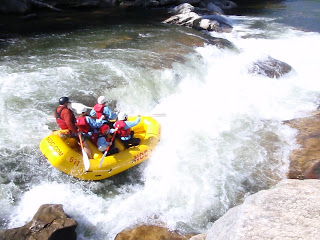
Big, splashy waves of the Middle Ocoee

5. Save some money. It’s a strange world where we can offer premium trips at lower cost, but due to the demand curve that’s just how the rafting business works. Who wins in this situation? Rafters. So take advantage of this quirk and book a spring rafting trip. You’ll be able to see the available savings here, and you’ll help “green up the mountains” by keeping some of that cash in your own back pocket.

Monday, June 27, 2011

Chattooga Section IV: the "Ultimate Whitewater Experience?"

This blog has moved. You will be redirected to the new blog in 5 seconds. If your browser does not redirect, please click the following URL:

http://www.noc.com/blog/chattooga-section-iv-the-ultimate-whitewater-experience/

Before I had a driver's license I paddled whitewater rivers two ways: 1) finding rides with driving-age friends or 2) "paddling vicariously" through guidebooks. Being from Georgia I had William Neely's illustrated Whitewater Home Companion: Southeastern Rivers Volume One, Monte Smith's new-at-the-time Southeastern Whitewater and the classic Appalachian Whitewater: The Southern Mountains. Thanks to the accounts in the books I understood the conversations of "real" paddlers, and I knew routes through rapids I'd never even seen. I read each page of the books until I knew every detail about the Ocoee, Nolichucky, Gauley and, of course, Chattooga Section IV.

Even before I ran my first Class IV rapid I knew that running Section IV was my paddling goal even though there were bigger, more difficult rivers in the books. Why? Partially because Section IV was so famous for its contributions to the movie Deliverance, but also because the authors of the books didn't write the same way about Section IV as they did about other rivers.


When authors discussed Section IV I could detect the unique respect. My copy of Appalachian Whitewater reads: "The scenery is nothing short of spectacular for almost the entire length of the river. Its excellence rivals any river in this country." The writers continue, "...the reputation of Section IV as an ultimate whitewater experience is probably what brings throngs to the Chattooga."

Southeastern Whitewater reads: "For a few years after the release of [Deliverance], this stream was the sine qua non of whitewater paddling... Section IV remains a formidable stretch of whitewater. The run is unique in many ways, and it's always a treat. Few rivers live up to their reputation. Section IV does." The latter book even tried to quantify the Chattooga's reputation, assigning it a "reputation value" of 139 on a scale where 100 was the midpoint. This was one of the highest in the book.


Part of what makes the Chattooga special is Section IV's famous Five Falls. The Five Falls are five Class IV-V rapids in quick succession near the end of the run. Monte Smith described these as, "...something else. Few other one-third mile stretches exceed it for sheer excitement... the Five Falls have to be seen to be appreciated. As the water rises about 2.0 feet, the falls progressively lose their individuality as they blend into an uninterrupted maelstrom of frothing, crashing, churning, exhilarating whiteness" (Southeastern Whitewater). I would stare at the book's photos and anticipate my own future approach to the "launching pad" ledge at Soc-em-Dog, the river's Class V finale, hoping to get my line just right.

As I grew up I progressed and made it down Section IV finally. I even started running rivers supposedly more difficult than the Chattooga like the Tallulah and the Cheoah, but I noticed that, even after a few runs on each river, I didn't get nearly as anxious or as excited about those rivers as I did about Section IV. At the other rivers' big rapids I was much more relaxed and conversational than I ever would be above, say, Jawbone on the Chattooga. Why? Probably because I didn't know as much about these other rivers, and I hadn't built the rapids up for years in my mind. But maybe this is also what it's like playing baseball at Wrigley Field or racing at the Brickyard: you just enjoy being a part of it.


That said, there are some objective reasons why you'd be a bit more focused at the Five Falls: first the river's been pretty friendly until you get here. Yes, Woodall Shoals, Seven Foot Fals and Raven's Chute are big, fun, challenging rapids, and then there are all the bouncy smaller rapids too, but the Falls are totally different. The atmosphere changes; the wide open, sunny river closes into a constricted gorge. Direct sunlight fades behind the raised treeline. The river gets loud toofive big rapids that close together make an impressive white noise backdrop. Plus, everyone in your group who was splashing around and jovially goofing off at the lunch spot is suddenly more focused.


Looking downstream from the top rapids you can see water splashing up from the far side of horizon line ledges, and you know there's another pretty steep rapid right after the one you're about to run. This makes you a bit more focused on getting things just right.


Despite the action at the Five Falls, I think that the river's wide range of experiences and moods is why it's the "ultimate river experience". When it's relaxed, it's as casual and benign as a river can be: you're swimming in lazy warm pools, jumping off rocks into the gentle current, walking under beautiful waterfalls and eating lunch on sandy beaches. But when things start to pick up the action gets going. The rapids on Section IV tend to drop over ledges and broken ledges, making them fast and technically challenging to the guides and paddlers, and when the rapids come in quick succession, things get intense.


At the end of the trip you float into the flatwater Lake Tugaloo, and you've got time to reflect on the experiences of Section IV. This is one more feature I love about the river; it's got a good narrative form, with solid rising action, a clear climax at the Five Falls and a pleasant denouement crossing the lake. The Chattooga doesn't easily allow you to "squeeze it into your schedule" or "just do the biggest part." You've pretty much got to experience the whole thing.


This is a big reason why the Chattooga is a true wilderness experience. Not only is it protected as a Wild and Scenic River (which means you won't see many rafts while you're out there), but it's also deliberate. The river demands that you invest some real attention in your surroundings and your companions, not just the rush and thrill of the rapids.

At NOC, where we work and play on rivers all across the Southeast and the world, Section IV is still one of our staff's most beloved whitewater rivers. It's probably the trip I'd select if I was trying to demonstrate to someone why I love rivers and rafting as much as I do. On most other rivers I'd talk about the rapids and the scenery to describe why it's so great, and I'd do that for the Chattooga too, but the reason it's so great to me is its "aura." The Chattooga just has something other rivers don't.

*See pages 32-39 in Appalachian Whitewater and pages 107-121 in Southeastern Whitewater for the sources of the excerpts above.

Wednesday, June 22, 2011

Going to Water: Chattooga Section III

This blog has moved. You will be redirected to the new blog in 5 seconds. If your browser does not redirect, please click the following URL:

http://www.noc.com/blog/going-to-water-chattooga-section-iii/

I have been in love with rivers for as long as I can remember. The rush and crash of rapids, hidden waterfalls pouring into shaded mountain streams, the warm lazy flow of a river too old to hurry. All provoke images of summertime vacations in the mountains, fingers sticky with strawberries from riverside picnics, my father's rough steady hands as he guided our canoe through a maze of rocks and tree limbs on to safer waters. Throughout my adolescent years I was fortunate enough to see a lot of whitewater. The mountain rivers and the adventures we had on them became a knot that tied my father and I together even when I forsook bedtime stories and stuffed animals for boys and makeup. But when I was in high school my father suddenly passed away. The family trips to the river stopped and it felt like my canoe was adrift without a guide.

The next time I braved whitewater would be years later on summer vacation with some friends from college. They managed to talk me into a full day excursion with the Nantahala Outdoor Center on Section III of the Chattooga River in Mountain Rest, South Carolina. A few weeks later I found myself seated in the front seat of a 95 Taurus watching the suburbs give way to pine trees and misty hills. Valleys and green slopes hung wet and shining with the rain from the night before as the pink light of sunrise seemed to spill over the peaks of each hill like water
breaking free of a dam.

The Chattooga River is a river that seems to be caught between two worlds. Designated a wild and scenic destination by the Wild and Scenic Rivers Act of 1974, only 15 miles of it is available for recreational use. The rest of its 57 miles are completely wild and protected by the Sumter National Forest on the South Carolina side and the Chattahoochee National Forest on the Georgia side. Originally belonging to the Cherokee Nation, the Chattooga River was a point of constant contention between the Cherokee who viewed the river as sacred and the Scotch-Irish settlers that wanted to exploit the area for logging and mining in the 1800's. Today the Chattooga runs the border between South Carolina and Georgia, as if it can't quite decide where it belongs. Its a river torn between two times, harkening back to the old world yet constantly threatened by the progress of today.

We arrived at the NOC Chattooga Outpost around 8 am and the staff were very courteous and time efficient. We watched a safety video and our trip leader gave us a trip talk before we put on our helmets and PFDs and boarded the bus for a quick bus ride to the top of the river. Everyone helped carry gear and rafts about ¼ of a mile down to the put in because of Forest Service regulations that prohibit automobile traffic too close to the river. The air was thick with the smell of damp Earth and honeysuckle. The dense pines crowded over us and the rush of the river grew louder with each step. The sound was an aching reminder that this was the first time I would face the river without my father by my side.


When we reached the bottom the trip leader assigned us our guide, a tan shaggy-haired guy in his twenties. In our boat it was the four of us and a couple in their thirties. We all piled in and then headed out. The dark cool water snaked out before us and the sun blazed just over the tree line like a beacon. I hadn't quite anticipated how isolated the Chattooga River was from the outside world. Apart from our trip, there wasn't another raft or boat in sight. A hawk sailed in low circles above us and our guide pointed out a river otter just as it disappeared beneath the surface. There was no sound of traffic, just the river pounding louder with each paddle stroke. River water filling up my veins, sunlight in my eyes. All of it reminding me of times past.

Our guide explained that the Chattooga was a “drop-pool river” consisting of ledges and drops that make up the swift rapids and brief calm pools afterward. As we went over each rapid he ordered us all to lean in and paddle. My friend Jackie and I were seated in the front and constantly found ourselves drenched by waves of water (which the rest of our boat found very entertaining). We plummeted through rapids with names like Warwoman, Dicks Creek, and Sandy Ford that ranged from Class II to Class IV.


We pulled over for lunch on a sandy beach around 11:30 and the raft guides arranged a a great sandwich spread on the bottom of an overturned raft covered in a picnic blanket. We could choose from ham, turkey, PB& J or a delicious hummus spread for our sandwiches. They also included chips, some veggies and dip, and cookies for dessert with lemonade and sweet tea to drink. Several of the kids on the trip took the opportunity to go swimming in a little class I rapid that ended in a calm pool. My friends seized their "inner kid" too and leapt into the rapids, shouting for me to follow. Instead I just lay back on a large rock jutting out into the water and marveled at the way the river still managed to make me feel peaceful and free after all that time.


After lunch we took on a few more Class III rapids before pulling over and preparing for the big Class IV rapid on the trip, Bull Sluice. Everyone got out of the rafts to walk up a rock outcrop to take a look at the broken ledge and white frothing whitewater below before deciding whether or not we wanted to go down or take the foot path to the other side. As soon as we got to the top of the outcrop the sky turned ominously dark and rain began falling in great sheets. Two of my friends took one look at the rapid and then instantly took the trail to walk around. Me and Jackie stood looking at the roaring rapid and rushing water churning over the drop. She glanced at me and grinned. I knew at that point that we were going over,whether I liked it or not.


We walked back to the boats and took our seats up front and our guide ferried back out into the swift current. My heart pounded in my chest as we were borne swiftly toward the drop. Glancing to my left I noticed that Jackie's face didn't look quite so confident anymore. Thunder cracked overhead and the guide shouted over the storm to get down. Jackie and I scrambled to sit in the bottom of the boat as we plummeted over the drop and into a wall of water that briefly submerged the whole raft. In seconds it was all over and we were back on the surface of the water, safely in the boat, and paddling our way into the calm eddy waiting for us on the other side. As terrifying as the rapid had been in the moment, I was immensely glad that I had tried it. Looking over my shoulder at Bull Sluice, I realized how much braver I had gotten over the past few years. As a kid I never would've been fearless enough to tackle a drop like that, even with my father at the rudder.

Shortly before we reached our take out point at the end of Chattooga Section III our guide told us a story about the Cherokee people that used to live in the area. A long time ago they believed that the Chattooga was sacred because if you followed the river back to its origin it would lead you into the spirit world. Therefore, they would “go to water” and immerse themselves in the river to cleanse and heal their souls. The sound of the rapids roaring and crashing was really the voice of the father of the river, a god called “Long Man” who was using the water to converse with spirits in the other world.


As we boarded the bus at the end of the river and headed back to the center I thought about how my trip on the Chattooga had been, in a way, my “going to water”. It helped along on the
road to healing and it gave me the bravery to embrace a passion that I had, long ago, let slip away. And as the bus engine roared and the sound of the river faded behind me, I couldn't help but think that I heard a familiar voice in the rapids, whispering words of encouragement and love from a distant world.

Tuesday, March 15, 2011

Spring Whitewater Rafting: Five Reasons to Paddle Before Summer

"Spring rafting!" Words that should energize whitewater lovers everywhere. Think farmer john-style wetsuits, pushy, strong whitewater, flowering trees, fresh air and—more than anything—getting outside and back in nature. Yet, there's a relatively low amount of interest in spring rafting.

Sure, summer is when people have time off, it’s warmer outside, the kids are out of school and there's more free time. Unfortunately though, rivers are usually at their most adventurous early in the season, and all of us at NOC would love to see more river lovers on the water in March, April and May. So, to inspire more spring adventures, here are five reasons why this is a great time to hit the water:

Seven Foot Falls, Chattooga IV

1) “When the Rain Comes…” Historically spring rains provide the best water levels of the year. We’ve had a pretty wet month so far here in Wesser, but we’re still just over half of our average six inches of rain. As I write this the French Broad, Chattooga and Nolichucky are running at beefy flows, and we’re getting a another good set of showers. Bottom line: This weekend, and other weekends throughout the spring, you can bet it will be splashy and exciting out there on the water.

It’s true that rivers tend to channelize water, and that summer flows are more than powerful enough to make plenty of splashes and waves, but big spring runs are the sometimes the best; they're often the stories we recall years later both as guides and paddlers.

2) Supply and Demand: You know the idea: we have less demand for spring rafting trips, which translates into savings for rafters. Interestingly, some of the best prices we offer all year are for trips when the excitement level is topping out.

Examples of savings? Well, you can save over over 10% at the Chattooga, Nolichucky and French Broad, and almost 10% on the Nantahala. The big discounts? The Ocoee and Pigeon are over 25% off full price in the spring.

3) No Need to Share: Another reason to enjoy spring rafting: you're probably going to have the river more to yourself in the spring. It's likely your rafting trip will be a bit smaller and more private, and it's almost certain there will be less river traffic outside of your trip. This means you're more likely to stumble upon wildlife or have more time to enjoy waterfalls or other riverside points of interest. See the photos below for some stops on the Chattooga and Nolichuky.

Long Creek Falls, Chattooga River

Secret Location, Nolichucky River

4) Availability: In the spring NOC rafts all seven of our rivers. Not only that, but we really offer 11 rafting trips (add Chattooga Section III, Lower Pigeon, Lower Nolichucky, and Full-Day French Broad to their better-known counterparts). This is when you have the most options to get on any NOC whitewater river. If it's late-August, we're often only running five rivers, and then only one trip on some of these. So, if there's a trip you've always aspired to do; this is the best time to book it.

5) "Because it's there." Attribute this sentiment to legendary mountaineer George Mallory or river-running Lewis Medlock from the film Deliverance, either way, it's the same idea behind all adventures and adventurers: experience the outdoors because you can. These trips are different and exciting. If you've never run whitewater at high water then you've missed one of the most exciting things you can do outdoors in the Southeast.


The rivers/trips to catch this spring:

1) Chattooga Section III: The upper section on the Chattooga is usually runnable through the season, but with spring rain we may be able to start at one of the alternate put-ins upstream like Earl's Ford, Sandy Ford or Fall Creek. This means a bit bigger whitewater and more river to see.

Bull Sluice, Chattooga III/IV

2) Nolichucky: The Nolichucky has the shortest season of all NOC rivers and because of this it sometimes gets forgotten by late summer, but this is one our staff's favorite trips. In the spring the upper part of this run can get pretty big, and Quartermile rapid becomes one of the longest and most difficult rapids we run. Even if you miss a high-water event, there should be healthy flows through the spring and the scenery here is without match in the East.

Spring on the Nolichucky
(Most major rapids are upstream of this photo.)

3) French Broad Full Day: Imagine a big Ocoee with plenty of giant splashy waves, that's the FB at high water. You can also catch the rare "Seldom Seen" wave/hole that forms at Frank Bell's rapid. This enormous river feature will certainly drench everyone in a raft. Again, even if you miss a high water event, the FB at spring flows is typically faster and a bit more action-packed.

Paddling the Ledges on the French Broad.

4) Section IV Chattooga: Running Section IV at high water provides serious Class V action, and it may be the most white-knuckle recreation you can have with NOC. At some levels we still run through the five falls (scary, but reasonable), and at the highest levels we run monster versions of Bull Sluice, Seven Foot Falls and Raven's Chute.

Corkscrew, Chattooga IV

5) Cheoah: The main reason to raft the dam-fed Cheoah in the spring is because that's just Cheoah season—over half the river's few releases take place before June. Extra rain flowing in from the Cheoah's feeder creeks will certainly make an intense trip even more intense though.

Photo Wave, Cheoah River

By the way, our dam-controlled rivers like the Nantahala, Ocoee and Pigeon can have high flows too, though these tend to be mitigated by the dam. To book an exciting spring rafting trip call 888.905.7238 or visit noc.com.